Propagating Neutral Modes in an Intervalley Coherent State

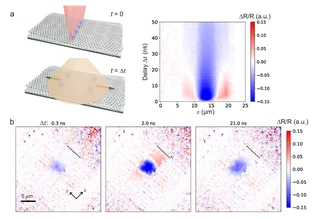
Elementary excitations in quantum systems govern their responses to intrinsic and extrinsic stimuli, such as phase stabilities and device operations. Emergent collective excitations – magnons, spinons, Majorana modes etc. – are often the hallmark of exotic quantum states and can open up new device concepts with transformative performance. However, directly probing and isolating these excitations has been challenging because many of them do not couple to charge and therefore show weak responses in electrical measurements. Furthermore, they typically coexist with other conventional excitations that show stronger responses, such as charged quasiparticles, and are therefore eclipsed by the latter in steady-state measurements that measure total responses. Our mission was to develop an optical method to directly visualize charge-decoupled excitations in moiré materials.
To overcome these challenges, we developed a space-and-time-resolved pump-probe technique to image pure spin-valley modes in twisted WSe2 moiré superlattice. First, we probe these excitations by encoding them into excitons and reading them out optically. This “exciton sensing” concept is very general, leveraging versatile interaction channels between exciton and collective excitations, such as dielectric screening or, in our case, phase-space filling. By shaping the pump laser to inject a localized packet of excitations and tracking its space-time evolution with a delayed wide-field probe, we captured non-equilibrium transport of these excitations. The combined spatial and temporal resolution enabled us to directly capture and separate multiple coexisting modes based on their distinct propagation behaviors.
Near the van Hove singularity (VHS), we discovered two new propagating collective modes. These modes travelled with drastically different velocities and, surprisingly, carried opposite spin-valley currents. One mode propagates at a large speed of >3 km/s and shows partial ballistic behavior, consistent with a gapless excitation; while the slower mode shows diffusive behavior and is likely a gapped excitation. Together, these behaviors can be naturally explained by phase (Goldstone) and amplitude (Higgs) mode of a spin-valley superfluid. Indeed, this spin-valley superfluid is predicted to appear in twisted WSe2 moiré superlattices when electrons spontaneously break the U(1) valley rotation symmetry and enter an intervalley coherent state (IVC), i.e., a coherent superposition state of the K and K’ valleys.
The observation of new collective modes provides strong evidence of an IVC ground state. Recently, superconductivity has been discovered in adjacent regions of VHS. Studying these collective modes may help resolve the relation between the IVC and superconducting states, along with the underlying superconducting pairing mechanism. Furthermore, the IVC state, as a spin-valley superfluid, supports spin-valley supercurrent. Such new type of superfluid is a long-sought-after phenomenon for spin- and valleytronics but has remained elusive in experiments. Our results enable direct visualization of spin-valley currents, whose behaviors are consistent with a spin-valley superfluid. On the other hand, demonstrating truly dissipationless spin-valley transport will require more quantitative analysis, which relies on future improvements in both device fabrication and measurement capabilities. Finally, our space-time imaging technique can be readily applied to other collective modes in a broad range of material systems. One example is twisted MoTe2, which is predicted to host exotic excitations including fractionalized excitations and magnetorotons in its fractional Chern insulator state. The non-equilibrium nature of our probe allows overcoming intrinsic limits of steady-state measurements and separating new excitations from conventional ones dynamically. In addition, by tracking the emergence and evolution of each collective mode in the phase diagram, our technique provides a powerful tool for uncovering hidden orders that were difficult to access. The IVC state observed here is one example. Similar concepts apply to a plethora of intriguing phases such as excitonic insulator and quantum spin liquid.
